
Softwashing vs Pressure Washing: Which Method Suits Which Surface?
Compare softwashing and pressure washing across render, paving, masonry, decking and other exterior surfaces, with a surface-first approach to method choice.

On this page
Softwashing and pressure washing can both be effective exterior-cleaning methods, but they solve different problems in different ways.
Softwashing relies primarily on a suitable cleaning or biocidal treatment applied at relatively low pressure. Pressure washing relies primarily on the mechanical force of water to remove contamination from the surface.
Neither method is automatically safer, gentler or better.
A low-pressure chemical can still damage an incompatible surface, surrounding vegetation or coatings. A pressure washer can clean a suitable hard surface extremely effectively when pressure, nozzle, distance and technique are properly controlled.
Choose the method from the surface, contamination and manufacturer guidance - not from the machine you happen to own.
Softwashing vs pressure washing: the quick difference
| Consideration | Softwashing | Pressure washing |
|---|---|---|
| Primary cleaning action | Suitable chemical treatment | Mechanical force of water |
| Application pressure | Relatively low | Can range considerably depending on machine, nozzle and surface |
| Often considered for | Biological contamination on compatible exterior surfaces | Sound hard surfaces where mechanical cleaning is appropriate |
| Main risks to control | Chemical compatibility, concentration, exposure, overspray and runoff | Surface damage, joint disturbance, water ingress, overspray and runoff |
| Universal method? | No | No |
Sometimes one method is clearly more appropriate. Sometimes a professional process uses controlled mechanical cleaning and a suitable chemical treatment at different stages.
Start with the surface, not the cleaning method
Before choosing softwashing or pressure washing, establish:
- what the surface is made from;
- whether it has a coating, finish or sealer;
- its age and visible condition;
- what type of contamination is present;
- whether joints, edges or fixings are vulnerable;
- what the manufacturer recommends;
- where water and chemical runoff will go;
- and what result the customer actually expects.
Where the material or finish is uncertain, start with the least aggressive suitable approach and test an inconspicuous area before committing to a larger section.
A method that works well on one driveway, render system or decking product should not automatically be copied onto another simply because the surfaces look similar.
Which method suits common exterior surfaces?
| Surface | General approach | Main checks |
|---|---|---|
| Render | Manufacturer-led; controlled washing or suitable treatment may be appropriate depending on the render | Render type, finish, cracks, exposed edges and product guidance |
| Brick and masonry | Use a method appropriate to the masonry, mortar and contamination | Weathered joints, coatings, efflorescence, historic or delicate material |
| Block paving | Controlled pressure washing is commonly suitable for sound paving | Jointing material, surface condition, pressure and nozzle control |
| Concrete | Controlled pressure washing can suit sound hard concrete | Surface finish, damage, coatings and joints |
| Natural stone | Use conservative pressure and compatible chemistry | Stone type, porosity, weathering and sensitivity to chemicals |
| Porcelain paving | Cleaning method should follow the paving supplier's instructions | Jointing, coatings, stains and surrounding materials |
| Timber decking | Use particularly careful mechanical cleaning | Timber condition, grain damage, coatings and manufacturer guidance |
| Composite decking | Product-specific manufacturer guidance is essential | Decking generation, pressure limit, nozzle and working distance |
| Cladding and uPVC | Low-pressure cleaning or suitable treatment may be more appropriate | Material, seals, coatings, joints and chemical compatibility |
| Painted surfaces | Use a cautious method appropriate to the coating | Paint condition, adhesion and chemical compatibility |
| Roofs | Roof-covering and manufacturer guidance should determine the method | Tile/material type, condition, access and cleaning restrictions |
This table is a starting framework, not permission to clean every example in the same way.
Render: do not assume pressure washing is forbidden
Render is a good example of why simplistic exterior-cleaning rules fail.
You will sometimes hear:
“Never pressure wash render.”
That is too broad.
Weber's current guidance says some of its rendered surfaces can be cleaned using a pressure washer with a fan action rather than a concentrated jet, while specifically stating that pressure washing is unsuitable for dry-dash finishes.
The correct question is therefore:
What render system is this, what condition is it in and what does its manufacturer permit?
Cracks, loose material and damaged edges should be addressed before directing pressurised water at the surface.
Where biological contamination is the main issue, an appropriate treatment may also form part of the cleaning process if it is compatible with that particular render.
Paving, concrete and hardstanding
Pressure washing is particularly useful on many sound hard surfaces, but “hard” does not mean impossible to damage.
Block paving
Block paving can commonly be pressure washed using an appropriate technique.
The joints need attention because excessive or poorly directed pressure can remove jointing material as well as dirt.
Inspect the surface and joint condition before cleaning and allow for any appropriate reinstatement after the surface has dried.
Marshalls currently advises using no more pressure than necessary for its paving and warns that excessive force can damage both the paved surface and the joints.
Concrete
Sound concrete can often tolerate more mechanical cleaning than softer or more delicate exterior finishes.
Still check for:
- surface deterioration;
- paint or coatings;
- repairs;
- decorative finishes;
- and vulnerable joints or edges.
Imprinted or coated concrete should not automatically be treated like ordinary unfinished concrete because the visible finish may be the part most vulnerable to an aggressive cleaning method.
Natural stone needs a more conservative approach
“Natural stone” covers materials with very different characteristics.
Sandstone, limestone, granite and other stones should not be treated as one generic pressure-wash category.
Porosity, weathering, surface finish and chemical sensitivity can all vary.
Marshalls recommends a lower-pressure approach for natural stone and sandstone because excessive pressure can contribute to erosion over time.
That makes test cleaning particularly important.
Use enough mechanical action to achieve the required result without treating maximum machine pressure as the default setting.
Chemistry needs the same care. A product that works well on one masonry surface may discolour, etch or otherwise affect another.
Composite decking proves why manufacturer guidance matters
Composite decking can look broadly similar across different products while having very different cleaning instructions.
Trex currently permits pressure-washer use on certain modern products within specified limits, using a fan attachment and minimum working distance.
However, Trex separately says pressure washing is not recommended on some earlier-generation products because it can damage the surface.
That makes a universal statement such as:
“Composite decking is safe up to X PSI.”
poor professional advice.
Identify the decking system where possible and follow the instructions for that product.
The same principle applies to timber, painted decking and coated surfaces.
What about cladding, uPVC and painted surfaces?
These surfaces often reward restraint.
High pressure can force water into joints, disturb seals, damage paint or create visible marks even where the underlying substrate is robust.
A suitable low-pressure wash, brush or compatible cleaning treatment may therefore be a better starting point.
Before applying chemicals, consider:
- the material itself;
- paint or coating compatibility;
- rubber seals;
- metal fittings;
- glass;
- and anything below the application area that may receive runoff.
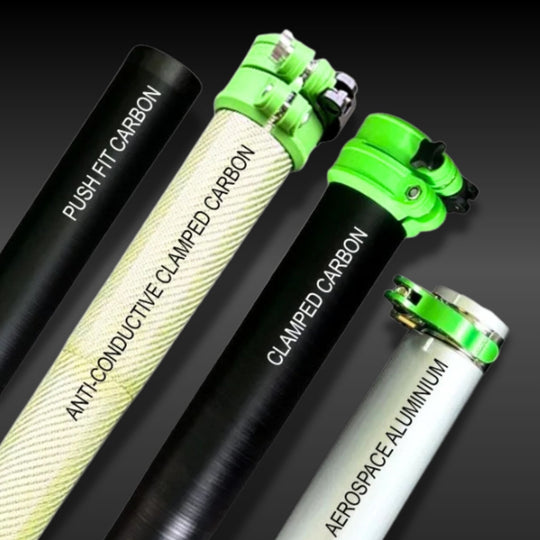
If you already use professional telescopic cleaning poles, the GVS Soft Washing collection provides the relevant application route once the method and chemical have been established.
Roofs need a separate decision process
Do not extend the recommendations for patios, walls or driveways to roofs.
A roof contains coverings, laps, fixings, junctions and potentially fragile materials whose performance can be affected by the direction and force of water.
Some roof-tile manufacturers specifically discourage high-powered jet washing.
Roof scraping, suitable chemical treatments and controlled water cleaning therefore need to be considered around the actual roof covering and manufacturer instructions.
Read Roof Cleaning Methods: Scraping, Softwashing and Pressure Washing before applying this wider surface guide to roof work.
Softwashing is not simply another word for bleach
Softwashing describes a cleaning method, not one universal chemical recipe.
A professional process may use a cleaning or biocidal product suited to the contamination and surface involved.
Whatever product is chosen, check:
- what it is intended or authorised to be used for;
- the label directions;
- the required concentration or application rate;
- surface compatibility;
- PPE and exposure controls;
- storage;
- overspray;
- and environmental precautions.
Using less application pressure does not remove the hazards associated with the substance itself.
HSE guidance requires hazardous cleaning substances to be assessed under COSHH where applicable. The Safety Data Sheet helps identify hazards and safe handling information, but it is not itself the complete COSHH assessment.
See HSE guidance on carrying out a COSHH risk assessment.
Can softwashing and pressure washing be used together?
Yes, where both stages are suitable for the surface.
For example, a professional process on compatible hard paving may involve mechanical cleaning followed by an appropriate treatment for remaining biological contamination.
Alternatively, a suitable treatment may be used before controlled mechanical cleaning where the product instructions and surface support that process.
The important point is that the methods should have distinct purposes.
Do not add chemicals simply because pressure washing is already being carried out, and do not pressure wash merely because a chemical application did not produce an immediate cosmetic change.
Each stage should solve a defined part of the cleaning problem.
Do not use one universal pressure setting
There is no professional PSI chart that can safely replace identifying the surface.
Pressure at the surface is influenced by more than the machine's maximum rating.
It also depends on:
- nozzle type;
- spray angle;
- flow rate;
- distance from the surface;
- movement speed;
- and the condition of the material.
A professional pressure washer capable of very high pressure does not need to be used at maximum aggression on every job.
Control is more valuable than simply having the biggest machine setting available.
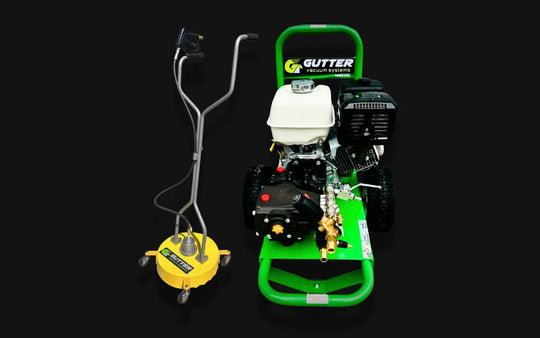
Once pressure washing is established as the appropriate method, use the GVS Pressure Washing Equipment hub to build the equipment around the work you intend to perform.
Always consider runoff before cleaning starts
Pressure washing does not create clean water simply because no chemical was deliberately added.
Wash water can collect:
- dirt;
- silt;
- oil;
- organic material;
- cleaning chemicals;
- and contamination removed from the surface.
Likewise, softwashing introduces the cleaning product itself into the runoff-control problem.
In England, Environment Agency guidance states that surface-water drains discharge directly to the environment and that contaminated business water should not simply be directed into them.
Depending on the situation, contaminated water may need to be contained for reuse or removal, or discharged to foul or combined drainage with permission from the water company.
Plan this before the cleaning begins rather than trying to stop dirty water when it is already approaching a drain.
See the Environment Agency pollution-prevention guidance for businesses for work in England.
A practical surface-selection workflow
- Identify the surface. Know the material, finish and coating where applicable.
- Inspect its condition. Look for cracks, loose joints, weathering, failing paint, damaged seals and other weaknesses.
- Identify the contamination. Biological growth, general dirt, oil and staining do not necessarily need the same process.
- Check manufacturer guidance. Do this before relying on generic pressure or chemical advice.
- Choose the least aggressive suitable method. Enough to do the work properly without unnecessary force or chemistry.
- Test an inconspicuous area. Particularly on weathered, coated, natural or unfamiliar surfaces.
- Plan chemical controls. Where softwashing products are used, address label requirements, COSHH, PPE and overspray.
- Plan wash-water management. Know where water will travel before it leaves the surface.
- Adjust the process as the surface responds. Do not keep increasing pressure automatically if the result is poor.
- Inspect the finished work. Check both the cleaned surface and any surrounding areas affected by the process.
Our practical recommendation
Choose softwashing when a suitable chemical treatment is the appropriate way to deal with the contamination on that particular surface.
Choose pressure washing when controlled mechanical cleaning is appropriate for a sound surface and the relevant manufacturer guidance supports it.
Use both where each stage has a clear purpose and the surface is compatible with the complete process.
Do not reduce exterior cleaning to:
soft surfaces = softwash, hard surfaces = pressure wash.
Render systems differ. Natural stones differ. Composite decking products differ. Coatings, joints and previous repairs change how even familiar materials respond.
The most professional question is not:
“Which cleaning method is more powerful?”
It is:
“What is the safest effective process for this surface, in this condition, with this contamination?”
Answer that first, then choose the equipment.
Quick Answers
Frequently Asked Questions
Find concise answers to common questions covered by this guide.
Is softwashing better than pressure washing?
Is softwashing safe for every surface?
Can you pressure wash render?
Can you pressure wash block paving?
Can you pressure wash natural stone?
Can you softwash and pressure wash together?
Do I need COSHH paperwork for softwashing?
Can dirty pressure-washing water go down a surface drain?
Related Advice
Keep Learning
Continue with related GVS guides before moving into equipment or support.

Continue From Here
Use The Guide, Then Choose What To Do Next
Keep researching or move into the most relevant GVS equipment or support area for this topic.
Need A Product-Specific Answer?
Need Help Applying This To Your Setup?
Tell the GVS team what you are cleaning, your working height and the equipment you already have. We can help you check the practical next step.