
Gutter Vacuum Power Explained: Airflow, Water Lift and Wattage
Airflow, water lift and wattage describe different parts of gutter vacuum performance. Learn what each figure means and how to compare systems properly.

On this page
Airflow, water lift and wattage are all used to describe gutter vacuum performance, but they do not measure the same thing.
Airflow tells you how much air the machine can move. Water lift describes its pressure or suction capability. Wattage tells you how much electrical power the motor system uses.
None of those figures, on its own, tells you how well a complete gutter vacuum will perform on every job.
A machine also has to move debris through a real suction route containing a nozzle, neck, poles, hose, inlet, drum and filters. Every restriction, bend, blockage or air leak can change what reaches the working end.
That is why comparing professional gutter vacuums purely by the largest wattage, airflow or water-lift number can be misleading.
Airflow, water lift and wattage: the quick answer
| Specification | What it describes | What it does not tell you alone |
|---|---|---|
| Airflow | The volume of air moving through the system, commonly shown by GVS in litres per minute (LPM) | How much pressure the vacuum can create against resistance |
| Water lift | The vacuum's ability to create a pressure difference, expressed as an equivalent column of water | How much air the machine can move through an open system |
| Wattage | The electrical input of the motor system | The actual airflow or water lift produced by the complete vacuum |
The best way to compare machines is to consider the figures together, then look at the hose, inlet, filters, drum, portability and type of work the system has been designed to handle.
What is gutter vacuum airflow?
Airflow describes the volume of air moving through the vacuum system over a period of time.
Within the GVS range it is commonly stated in litres per minute, or LPM.
Airflow matters because the moving air is what transports suitable debris through the nozzle, poles and hose towards the collection drum.
In simple terms, greater airflow gives the system more air movement available to carry material through the suction route.
This can be particularly useful when moving:
- loose leaves;
- moss;
- light organic debris;
- and other material that needs to travel through several metres of pole and hose.
But airflow alone is not the complete answer.
A vacuum can only move useful air through the system if that route remains reasonably open.
What is water lift?
Water lift is a way of describing the pressure difference a vacuum can generate.
The figure is expressed as the height of a column of water that the pressure difference could support.
For example, a vacuum specified at 100 inches of water lift has a pressure capability equivalent to supporting a water column approximately 100 inches high under the relevant test condition.
Water lift is therefore fundamentally different from airflow.
Airflow is about volume movement. Water lift is about pressure difference.
Pressure capability becomes particularly relevant when the air path encounters resistance.
That resistance may come from:
- long hose and pole runs;
- bends;
- a narrow or partially obstructed nozzle;
- wet or dense debris;
- a dirty filter;
- or a developing blockage.
It would still be wrong to say that whichever machine has the highest water lift will always clear gutters better.
The system also needs enough airflow to transport the material once it is moving.
Why airflow and water lift need to be considered together
A gutter vacuum is not normally working in a completely open system or a completely sealed one.
During an actual job there is airflow through the nozzle while the vacuum is also working against resistance from the poles, hose, filters and debris.
That means the useful operating performance sits between the two headline ideas:
moving air and maintaining pressure against restriction.
A useful analogy is to think about moving debris through a pipe.
You need enough air movement to carry the material along, but you also need enough pressure capability to keep that air moving when the route becomes restrictive.
This is why professional vacuum specifications commonly publish both airflow and vacuum-pressure figures rather than treating one as a replacement for the other.
What does wattage tell you?
Wattage describes electrical power input.
A 3600W gutter vacuum therefore has a larger stated electrical input than a 1700W machine.
What wattage does not tell you is exactly how that electrical input has been converted into:
- airflow;
- pressure capability;
- working efficiency;
- or useful performance at the nozzle.
Motor design, fan design, inlet size, airflow path and the wider machine construction all influence the finished result.
This is why two machines with similar wattage can have different airflow and water-lift figures.
It is also why a lower-wattage machine can still have a strong pressure specification.
Real GVS examples
The current GVS range demonstrates the difference particularly well.
| Gutter vacuum | Motor power | Airflow | Water lift |
|---|---|---|---|
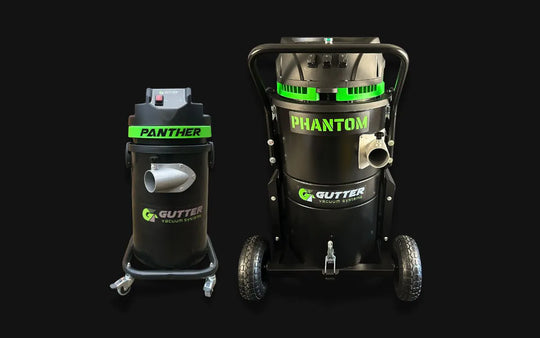
| Panther | 1700W | Over 4,500 LPM | 120″ |
| GVS-3K | 3000W | 8,000 LPM | 100″ |
| Shadow | 3400W | 8,000 LPM | 103″ |
| GVS-36 | 3600W | 10,000 LPM | 100″ |
| Predator | 3600W | 10,750 LPM | 95″ |
| Phantom | 3600W | 11,166 LPM | 82″ |
The table makes several useful points.
The Panther has the lowest wattage and airflow of these examples, yet the highest published water-lift figure.
GVS-36, Predator and Phantom all use 3600W motor systems, while their published airflow and water-lift figures differ.
GVS-3K and Shadow both provide 8,000 LPM airflow despite having different total motor wattages.
There is therefore no reliable shortcut such as “more watts equals more suction” or “higher water lift means the better vacuum”.
Each machine has its own balance of airflow, pressure capability, capacity, construction and intended workload.
You can compare the current GVS gutter vacuum systems once you know which characteristics matter most for your work.
Why the complete suction route matters
The figures measured at the vacuum do not remove the influence of everything connected to it.
A gutter-vacuum airflow path typically includes:
nozzle → neck → poles → hose → machine inlet → drum → filters → vacuum head.
Every part needs to work together.
Hose and pole length
Longer suction routes introduce more resistance than short ones.
This does not mean long gutter-vacuum pole systems cannot work effectively. It means machine performance and the airflow path need to be appropriately matched to the reach being used.
Bends and working-end geometry
Necks and hose bends change the direction of the airflow.
The correct neck is still necessary to reach the gutter properly, but unnecessary restrictions or badly matched components should be avoided.
Nozzle size
The nozzle affects both access and the opening through which air and debris enter.
A narrow specialist tool can be useful for particular areas while naturally providing a more restricted opening than a larger general-purpose nozzle.
Filters
A filter that becomes heavily loaded with debris can restrict the flow of air through the vacuum.
Filters therefore need to be kept in the condition required by the particular machine rather than being ignored until suction has noticeably deteriorated.
Our gutter vacuum maintenance guide covers the complete routine in more detail.
Blockages
A partial blockage can create substantial resistance long before the air path becomes completely closed.
If performance changes suddenly during a job, inspect the nozzle, neck, poles and hose rather than immediately assuming there is a motor problem.
Air leaks
A poor hose connection, damaged cuff or other unwanted leak can allow air to enter somewhere other than the working nozzle.
The machine may still be moving air, but less of that useful airflow is being drawn through the point where you actually need it.
How debris type changes the demand on the vacuum
Not every gutter contains the same material.
Loose dry leaves, wet moss and dense sludge present different challenges.
Loose and lightweight debris
High air movement is useful for transporting lightweight material rapidly through the poles and hose once it enters the nozzle.
Wet or dense material
Wet moss, mud and sludge can be heavier and may also restrict the working opening more easily.
The vacuum's pressure capability, tool selection and overall airflow path therefore become particularly noticeable.
Compacted material
A vacuum specification does not automatically break up debris that is physically stuck together.
Sometimes the correct neck, nozzle or dirt-breaking tool is what allows the vacuum to access and disturb the material before airflow can transport it.
That is another reason machine specifications and working-end tooling should be considered separately.
Why bigger numbers are not always the right buying decision
It can be tempting to compare gutter vacuums by sorting a spreadsheet from highest to lowest airflow.
Professional buying decisions involve more than that.
Consider:
- the type of properties you service;
- how frequently the vacuum will be used;
- typical working height;
- the debris you encounter;
- drum capacity;
- machine weight and portability;
- available electrical supply;
- hose and pole system;
- wet and dry working requirements;
- and the amount of equipment you need to transport.
A compact machine can be preferable where portability matters and the workload suits it.
A larger industrial system can make more sense where high airflow, greater capacity and demanding professional use justify the additional size and electrical requirement.
The correct specification is the one that solves the work efficiently rather than simply producing the biggest number in one column.
How to compare gutter vacuum power properly
Use this order.
- Check airflow. Understand how much air movement the machine is designed to provide.
- Check water lift. Consider the pressure capability alongside the airflow figure.
- Check wattage and power requirements. Make sure the site or generator setup can supply the machine correctly.
- Look at inlet and hose architecture. A strong vacuum still needs a well-designed airflow path.
- Consider the intended reach. Longer pole and hose configurations place additional demands on the system.
- Consider debris type. Loose leaves and heavy wet material do not behave identically.
- Check filters and wet/dry configuration. Make sure the machine can be operated correctly for the work you intend to undertake.
- Then compare capacity, portability and price. Power figures are part of the buying decision, not the whole decision.
Our practical recommendation
Do not buy a gutter vacuum because it has the highest wattage.
Do not buy one purely because it has the highest airflow or water lift either.
Look for the balance that suits the work.
Airflow tells you about the volume of air being moved. Water lift tells you about pressure capability. Wattage tells you about electrical input.
The complete gutter-vacuum system then determines how effectively those characteristics reach the nozzle through the hose, poles, filters and fittings.
For professional comparison, use the headline numbers to understand the character of the machine - then judge the complete system around the debris, reach, capacity and working conditions you actually encounter.
Quick Answers
Frequently Asked Questions
Find concise answers to common questions covered by this guide.
Is more wattage better on a gutter vacuum?
What is a good airflow for a gutter vacuum?
Is LPM the same as suction power?
What does 100-inch water lift mean?
Why can a lower-wattage vacuum have strong suction?
Can a dirty filter reduce gutter vacuum suction?
Do longer gutter vacuum poles reduce suction?
Should I buy the gutter vacuum with the highest airflow?
Related Advice
Keep Learning
Continue with related GVS guides before moving into equipment or support.
Continue From Here
Use The Guide, Then Choose What To Do Next
Keep researching or move into the most relevant GVS equipment or support area for this topic.
Need A Product-Specific Answer?
Need Help Applying This To Your Setup?
Tell the GVS team what you are cleaning, your working height and the equipment you already have. We can help you check the practical next step.