
Rigid vs Flexi Gutter Vacuum Necks: Which Should You Use?
Compare rigid and flexi gutter vacuum necks for working angle, access, tool control and compatibility, and learn where each design earns its place.

On this page
Rigid and flexi gutter-vacuum necks both do the same basic job: they change the direction of the suction route so the nozzle can sit inside the gutter.
The difference is in how they create and hold that working geometry.
A rigid neck gives you a fixed, firm working angle. A silicone flexi neck provides a lighter, more forgiving connection while still being supplied in a defined shape or angle.
Neither is universally better.
The right choice depends on the gutter, the angle you need to approach it from, the pole system you own, the nozzle you want to use and how much control you want at the working end.
Rigid vs flexi gutter vacuum necks: quick comparison
| Consideration | Rigid neck | Flexi neck |
|---|---|---|
| Construction | Fixed carbon-fibre geometry within the current GVS rigid range | Flexible silicone construction |
| Working angle | Stays firmly at the designed angle | Supplied in defined angles but with more give in the material |
| Tool control | Particularly useful where a fixed, direct working end is preferred | Useful where a lighter, more forgiving working end suits the access |
| Access | Different rigid angles solve different approach geometries | Available in several geometries for ordinary and restricted-access work |
| Nozzle compatibility | Depends on neck diameter and product family | Depends on neck diameter and product family |
| Pole compatibility | Current 51mm carbon rigid necks are designed around the GVS clamped-carbon system | Compatibility depends on pole family; some clamped-carbon setups require the correct insert or interface |
| Best overall? | Neither - many professional operators benefit from having more than one working-end option. | |
You can compare the wider GVS gutter vacuum neck and nozzle range once you know the connection and access problem you need to solve.
What is a flexi gutter vacuum neck?
A flexi neck is made from silicone rather than a rigid carbon structure.
One important point is that flexi does not mean infinitely adjustable.
The current GVS 51mm silicone range contains defined working geometries, including straight, 45°, 90°, 135° and 180° options.
The silicone construction gives the working end some flexibility, but you still choose the neck according to the general angle and access you need.
That makes flexi necks useful as a versatile part of a professional tool kit rather than as one universal neck that can be bent into every possible shape.
What is a rigid gutter vacuum neck?
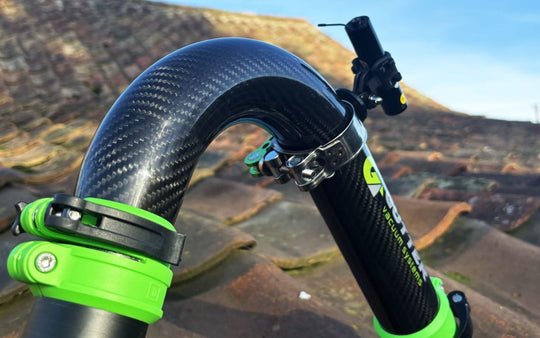
A rigid neck uses a fixed structure to hold the working end at its designed angle.
Within the current GVS 51mm carbon-rigid range, available geometries include:
- 45°;
- 65°;
- 90°;
- 135°;
- and 180°.
The fixed construction gives the operator a firm relationship between the pole and nozzle.
This can be useful when you want predictable tool positioning or a more direct feel while moving the nozzle around debris and gutter fittings.
It does not automatically mean that a rigid neck creates more vacuum power.
The vacuum still has to move air through the complete nozzle, neck, pole and hose route. Neck choice is mainly about access, geometry, compatibility and control.
Which is better for awkward gutters?
There is no single answer because “awkward gutter” can describe several different problems.
You may be dealing with:
- a conservatory forcing you to stand further back;
- a narrow passage where the poles need to remain relatively upright;
- guttering positioned close to tiles or roof edges;
- deep or boxed guttering;
- an outlet that needs a different approach;
- or brackets that make a normal nozzle position difficult.
A flexi neck may be useful where some give at the working end makes positioning easier.
A rigid neck may be preferable where you want the nozzle to hold a precise angle while being repositioned.
Often, the more important question is not simply rigid or flexi?
It is:
What neck angle puts the nozzle where it needs to be from the operator position available?
What is the best gutter vacuum neck angle?
There is no universal best angle.
Different neck geometries change where the nozzle sits relative to the final pole section.
| Neck geometry | Where it may be useful |
|---|---|
| Straight | Work where a large directional turn is unnecessary, including suitable channels and low-level access |
| 45°–65° | A shallower change of direction where the operator's approach already creates much of the required angle |
| 90° | A more pronounced turn into the gutter from a broadly upright or angled pole position |
| 135° | A stronger wrap-over geometry where the nozzle needs to return further towards the gutter channel |
| 180° | Restricted situations where the poles need to remain particularly upright and the working end needs to turn back towards the gutter |
The angle is not a rating of how powerful or professional the neck is.
A more extreme bend is only better when the property geometry actually requires it.
When does a 180° gutter vacuum neck make sense?
A 180° neck is a good example of why neck choice should be driven by access rather than by buying the biggest-looking angle.
On some properties, a fence, wall, narrow passage or neighbouring structure may prevent the operator from standing further back and creating the usual pole angle.
The poles may need to remain much more upright.
A 180° working end can then turn the nozzle back towards the gutter while the pole stays below it.
On an ordinary open elevation where the operator has plenty of room to stand back, that geometry may offer no useful advantage.
Use the angle that solves the property, not the angle with the largest number.
Can rigid and flexi necks use the same nozzles?
Sometimes - but diameter and product family matter.
Within the current 51mm GVS system, the 51mm nozzle range is designed to work with both the 51mm carbon rigid necks and the 51mm silicone flexi necks.
That makes it possible to change neck geometry without necessarily replacing the entire 51mm nozzle set.
But do not extend that rule to every GVS working end.
The 44mm system is separate. Its necks and nozzles should not be assumed compatible with the 51mm range simply because the parts serve the same purpose.
There is also a separate 46mm nozzle architecture associated with other carbon-rigid equipment.
Match diameter and connection first; then choose nozzle style.
Pole compatibility is just as important as nozzle compatibility
A neck that accepts your preferred nozzle is still the wrong neck if it does not connect correctly to your pole system.
Current 51mm carbon rigid necks
The current GVS 51mm carbon rigid necks are designed around the clamped-carbon pole system.
They should not be treated as a universal rigid upgrade for every pole that happens to be described as 51mm.
In particular, current GVS product information explicitly distinguishes these rigid necks from the aerospace-aluminium pole architecture.
Silicone necks and clamped-carbon poles
Suitable 51mm silicone necks can be used with the clamped-carbon architecture where the correct GVS insert or connection arrangement is fitted.
That is why a contractor changing from one pole family to another should check the whole working-end connection rather than assuming the old neck simply transfers across.
44mm systems
The GVS 44mm neck and nozzle range is its own ecosystem.
Those products should not be mixed into a 51mm setup without a specifically designed compatibility solution.
If you are not certain which neck fits an existing pole kit, use the GVS Spare Parts & Compatibility Guide rather than matching parts by appearance.
Does a rigid neck help with stubborn moss?
A rigid working end can provide a firm, predictable feel when you are positioning or agitating the nozzle around stubborn debris.
But the neck itself should not be treated as the debris-breaking component.
The nozzle or specialist working attachment has the more direct role in:
- disturbing compacted moss;
- reaching between brackets;
- accessing narrow areas;
- or opening up material before the vacuum transports it.
A rigid neck may therefore improve control for a particular operator and task without being inherently “better at suction” or automatically better at removing moss.
The best combination is the neck angle that provides access and the nozzle that suits the debris.
How does neck choice affect working height?
The neck adds working-end geometry to the top of the pole system.
It can move the nozzle:
- higher;
- further across;
- back towards the operator;
- or into a different approach angle.
That means changing the neck can solve an access problem even when the pole length itself has not changed.
It does not mean that changing from flexi to rigid, or from 90° to 135°, has increased the nominal pole length.
Our gutter vacuum reach and working-height guide explains that distinction in more detail.
Inspection cameras also need the correct neck mount
If you use a gutter inspection camera while vacuuming, neck choice affects more than the nozzle.
GVS camera brackets are available for different working-end arrangements, including:
- 44mm silicone necks;
- 51mm silicone necks;
- and carbon-fibre rigid necks in the appropriate sizes.
That does not mean one bracket automatically fits all of them.
Select the camera mount for the actual neck being used.
This helps keep the camera in the intended position and prevents a good camera system becoming poorly matched to the rest of the working end.
Our gutter inspection camera guide covers the wider inspection workflow.
Should you carry more than one gutter vacuum neck?
For regular professional work, often yes.
Properties vary too much for one working-end geometry to be perfect everywhere.
A sensible tool kit does not necessarily need every neck available, but having two or more genuinely different options can solve far more jobs than trying to force one arrangement into every gutter.
For example, an operator might choose:
- one everyday general-purpose neck;
- one more restricted-access geometry;
- and the nozzle types most useful for the debris commonly encountered.
Build the kit around the properties you actually service.
If you rarely encounter a situation requiring a 180° neck, there is no need to buy one simply to complete a set.
How to choose a gutter vacuum neck
- Identify your pole system. Confirm 44mm, 51mm or the relevant rigid-neck architecture and connection type.
- Identify the nozzle system. Make sure the neck accepts the nozzles you already own or intend to use.
- Look at your usual approach angle. Consider where you can stand in relation to the gutter.
- Consider restricted-access jobs. Walls, fences, extensions and narrow passages may justify a different geometry.
- Decide how much working-end firmness you prefer. This is where rigid vs flexi becomes relevant.
- Check camera compatibility. If you inspect while clearing, choose the correct mounting bracket for the neck.
- Then add specialist angles only when they solve a real problem.
Our practical recommendation
Choose a rigid neck when you value a fixed working angle and firm, predictable nozzle control.
Choose a silicone flexi neck when its lighter, more forgiving construction and available geometry suit the access and pole system you use.
Then make the angle decision separately.
A 45°, 65°, 90°, 135° or 180° neck is not better because of the number attached to it. Each changes the relationship between the pole and nozzle in a different way.
Finally, check the complete connection chain:
pole → neck → nozzle → camera mount, where fitted.
If those components are compatible and the neck places the nozzle where you can control it properly, you have the right working end for the job.
Quick Answers
Frequently Asked Questions
Find concise answers to common questions covered by this guide.
Which is better: a rigid or flexi gutter vacuum neck?
Is a flexi neck better for awkward gutters?
What is the best gutter vacuum neck angle?
What does a 180° gutter vacuum neck do?
Can rigid and flexi necks use the same gutter vacuum nozzles?
Can I use a flexi neck with clamped carbon fibre poles?
Can I use a rigid neck on aluminium gutter vacuum poles?
Do gutter inspection cameras fit both rigid and flexi necks?
Related Advice
Keep Learning
Continue with related GVS guides before moving into equipment or support.
Continue From Here
Use The Guide, Then Choose What To Do Next
Keep researching or move into the most relevant GVS equipment or support area for this topic.
Need A Product-Specific Answer?
Need Help Applying This To Your Setup?
Tell the GVS team what you are cleaning, your working height and the equipment you already have. We can help you check the practical next step.