
What Is a Gutter Vacuum and How Does It Work?
Learn how a gutter vacuum uses suction, high-reach poles and specialist tools to remove gutter debris, and what to consider when choosing a system.

On this page
A gutter vacuum is a high-reach cleaning system designed to remove leaves, moss, sludge and other suitable debris from gutters using suction.
The operator typically remains at ground level while lightweight poles carry the suction path up to the gutter. A neck positions the nozzle inside the channel, while a large hose connects the pole system to a powerful wet-and-dry vacuum below.
The principle is simple: the vacuum moves air through the nozzle, poles and hose, carrying suitable gutter debris back into the collection drum.
What makes a professional gutter-vacuum setup effective is not one component on its own. The vacuum, airflow path, poles, hose, neck, nozzle and filter all need to work together.
How does a gutter vacuum work?
A typical gutter-vacuum job can be understood in five stages.
1. The vacuum creates airflow
When the machine is switched on, its motor and fan system create a pressure difference that causes air to move into the suction opening.
In normal use, the working opening is the nozzle positioned inside the gutter.
2. Air and debris enter the nozzle
Leaves, moss and other suitable loose material are drawn into the working end with the moving air.
The nozzle matters because it determines:
- where the suction opening can be positioned;
- how large that opening is;
- and how easily it can access debris around brackets, outlets and awkward sections.
3. Debris travels through the poles and hose
Once material enters the nozzle, the moving air carries it through the neck, high-reach pole sections and suction hose.
The route needs to remain reasonably clear.
A compact blockage, heavily loaded filter, crushed hose or unwanted air leak can all reduce useful performance at the working end.
4. Material enters the collection drum
The removed gutter debris is carried into the vacuum drum, where it can be collected for appropriate disposal.
Wet-and-dry machines can also deal with suitable wet material when they are configured with the correct filter and wet-use arrangement for that particular vacuum.
5. Air passes through the filtration system
The vacuum's filters help protect the machine while allowing the airflow cycle to continue.
Filter type and configuration vary between machines and between wet and dry work, so the correct filter should always be used for the particular system and conditions.
What equipment makes up a gutter-vacuum system?
A professional setup normally contains several separate components.
| Component | Role in the system |
|---|---|
| Gutter vacuum | Creates the airflow and collects removed debris |
| Suction hose | Connects the vacuum to the high-reach pole system |
| Gutter-vacuum poles | Carry the suction route towards the gutter |
| Neck | Changes the working angle so the nozzle can sit inside the gutter |
| Nozzle | Creates the working opening and helps access different debris or gutter areas |
| Filter system | Supports the correct wet or dry operating configuration and protects the machine |
| Inspection camera | Optional equipment for surveys, live viewing and before-and-after checks |
| Power supply | Suitable mains power or a correctly specified generator where required |
One of the most common buying mistakes is concentrating entirely on the vacuum motor while treating the poles, hose and working end as secondary.
A gutter vacuum is a system, not just a machine.
What can a gutter vacuum remove?
A correctly configured professional system can be useful for common gutter debris including:
- dry leaves;
- moss;
- small twigs;
- loose organic debris;
- wet leaves;
- and suitable sludge or muddy material.
How easily material moves depends on its size, density and condition, as well as the nozzle, pole and hose route.
Loose dry leaves behave very differently from a dense mass of wet moss.
Material that has become compacted around brackets or tightly rooted vegetation may need to be disturbed with a suitable working-end tool before the vacuum can transport it effectively.
A more powerful vacuum does not automatically break apart debris that is physically stuck together.
Can gutter vacuums handle wet gutters?
Yes, where the vacuum is designed for wet-and-dry use and is configured correctly.
Wet moss, leaves and sludge are common in real gutter-clearing work, so professional systems need to account for those conditions.
The important point is the filter arrangement.
Different GVS machines use different wet-use filters and configurations. A washable sponge filter, cloth filter and HEPA cartridge should not automatically be treated in the same way.
After wet work, collected liquid and organic debris should be dealt with appropriately rather than being left sitting in the machine unnecessarily.
Our gutter vacuum maintenance guide explains the correct maintenance approach in more detail.
Why use high-reach poles?
High-reach poles extend the suction route from the vacuum towards the gutter while allowing many suitable jobs to be carried out from an appropriate ground position.
This can avoid unnecessary physical access to the roofline and remove the need to continually reposition ladders simply to move debris along a gutter run.
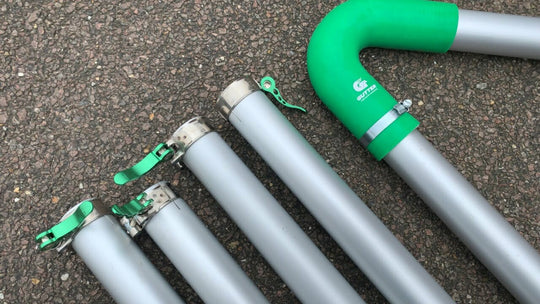
Different professional pole systems use different materials, diameters and connections.
Within the GVS range, these include aerospace aluminium and several carbon-fibre architectures.
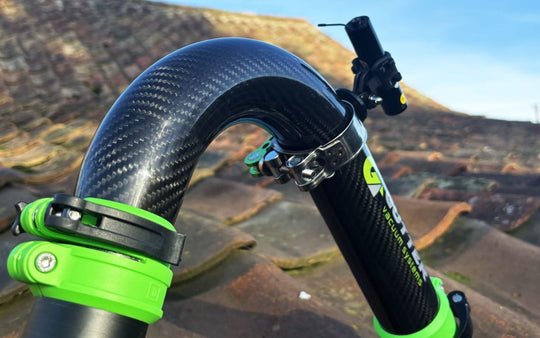
Carbon fibre is particularly attractive for frequent or greater-reach work because lower section weight becomes more valuable as additional pole length is assembled.
Aluminium remains a practical professional option where its additional weight is acceptable.
Read our carbon fibre vs aluminium gutter-vacuum pole guide before choosing purely from the material name.
How high can a gutter vacuum reach?
Current GVS gutter-vacuum pole systems are available in substantial professional configurations, including setups up to 40ft.
But pole length and working height are not the same thing.
A 30ft pole configuration does not guarantee that every 30ft-high gutter will be comfortably within reach.
Real working reach depends on factors such as:
- where the operator can stand;
- the angle of the pole;
- extensions and conservatories;
- walls and fences;
- ground level;
- neck and nozzle geometry;
- and whether the complete assembly can be controlled properly.
Our gutter-vacuum reach and working-height guide explains that distinction fully.
What do the neck and nozzle do?
The top of the final pole section is rarely where you want the suction opening to point.
A neck changes that direction so the nozzle can enter the gutter.
Different angles are useful because properties create different approach geometries.
A gutter above an open wall may be straightforward. A gutter beyond a conservatory, close to a roof edge or above a narrow passage can require a very different working end.
The nozzle then determines the shape and size of the actual suction opening.
Different tools can help with:
- general gutter debris;
- narrow areas;
- material around brackets;
- and compacted debris that benefits from agitation.
Do not assume that every neck or nozzle fits every pole simply because the nominal diameter appears similar.
Connection architecture matters as well.
If you are choosing the working end, read Rigid vs Flexi Gutter Vacuum Necks: Which Should You Use?
Why do airflow, water lift and wattage matter?
Gutter-vacuum specifications often use three numbers that are easily confused.
Airflow describes the volume of air being moved through the system.
Water lift describes the pressure difference the vacuum can generate.
Wattage describes electrical input.
They are not three different ways of expressing the same thing.
For gutter clearing, the vacuum needs a useful balance of airflow and pressure capability while working through a real suction route containing hose, poles, bends, filters and debris.
That is why buying whichever machine has the largest wattage number is not a reliable comparison method.
Our gutter vacuum power guide explains the technical differences without treating one number as universal “suction power”.
Do you need a gutter inspection camera?
No.
The camera does not create suction and is not required for the gutter vacuum to operate.
What it provides is visibility.
A professional inspection setup can help you:
- see how much debris is present before clearing;
- identify areas that may need a different working tool;
- monitor awkward sections;
- check the visible result afterwards;
- and provide useful before-and-after evidence for the customer.
This is particularly valuable because gutter clearing is often an invisible service from the customer's normal viewpoint.
See our gutter inspection camera guide for the complete workflow.
Can a gutter vacuum clear a blocked downpipe?
A gutter vacuum can remove material around the downpipe outlet and may remove accessible debris close to the opening.
That does not mean it should be treated as a dedicated drain- or downpipe-unblocking machine.
A camera may show that the visible outlet is clear, but it cannot prove that the entire downpipe is free from obstruction further below.
If the gutter remains full of water or drainage performance suggests an internal blockage, further investigation may be needed.
Clearing the gutter channel and clearing an internally obstructed downpipe are related problems, but they are not always the same job.
How is a gutter vacuum different from an ordinary wet-and-dry vacuum?
The underlying vacuum principle is similar: air movement is used to transport material into a collection drum.
What turns it into a professional gutter-clearing system is the way the complete equipment is designed around high-level debris removal.
That can include:
- higher airflow or pressure characteristics suited to the workload;
- larger inlet and hose arrangements;
- compatible high-reach poles;
- specialist gutter necks and nozzles;
- wet-use filtration;
- inspection-camera compatibility;
- and larger collection capacity.
A domestic vacuum being able to pick up wet material does not automatically make it a practical professional high-reach gutter system.
Does the biggest gutter vacuum always work best?
No.
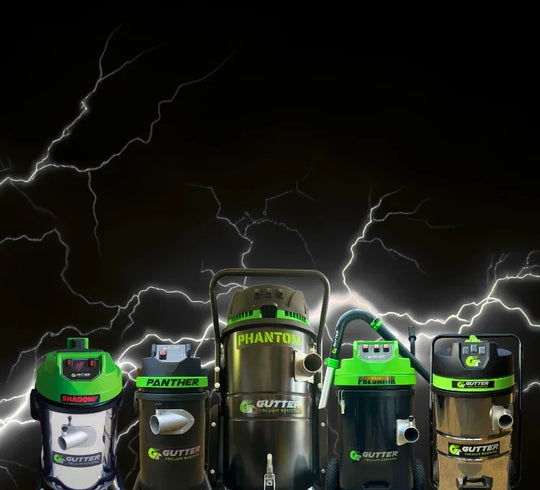
Larger machines can offer very high airflow, substantial drum capacity and the performance needed for demanding professional work.
They can also be physically larger, heavier and require more electrical power.
A smaller professional machine may make more sense for an operator carrying equipment through restricted properties and mainly servicing ordinary residential jobs.
When comparing systems, consider:
- airflow and water lift;
- typical working reach;
- debris type;
- drum capacity;
- machine weight and portability;
- electrical supply;
- pole material;
- hose architecture;
- and how frequently the machine will be used.
The GVS Gutter Vacuum Systems hub is the appropriate next step once those requirements are clear.
Ground-based gutter clearing still needs proper safety planning
One of the main advantages of high-reach equipment is that suitable gutter-clearing work can often be carried out without physically accessing the gutter.
That does not make every ground-based job automatically safe.
Long poles still need sufficient space to be raised, controlled and lowered.
Before starting, consider:
- overhead power lines and electrical equipment;
- wind and weather;
- ground conditions;
- pedestrians and vehicles;
- falling debris;
- restricted access;
- and the manual handling of the machine and collected material.
Overhead electricity deserves particular attention because long equipment can enter a hazardous area even while being raised or repositioned.
Use the GVS Health & Safety Hub when planning the working method.
How to choose your first gutter-vacuum system
Work through the decision in this order.
- Establish the properties you expect to service. Domestic, high residential and larger commercial work place different demands on the equipment.
- Estimate the reach you genuinely need. Consider obstacles and operator position, not just storey count.
- Consider the debris. Think about whether the work is generally light and dry or regularly includes wet moss and sludge.
- Compare airflow and water lift. Do not use wattage alone.
- Choose the pole system. Compare material, weight, diameter and connection architecture.
- Check the complete suction route. Hose, cuffs, neck and nozzles all need to work together.
- Plan power. Establish whether suitable mains electricity is normally available or whether a generator is required.
- Decide whether inspection should be part of the service.
- Consider transport and maintenance. The equipment needs to work between jobs as well as during them.
If you are building the equipment around a new professional service, our guide to starting a gutter clearing business takes that process further.
Our practical recommendation
Think of a gutter vacuum as a complete airflow system rather than simply a powerful wet-and-dry vacuum with long poles attached.
The machine creates the airflow and pressure capability.
The hose and poles carry that airflow to the gutter.
The neck and nozzle position it around the debris.
The filter and drum allow the machine to collect material and keep operating correctly.
An inspection camera can then add visibility before, during and after the work.
When those parts are correctly matched, a gutter vacuum provides a practical way to remove suitable high-level gutter debris while allowing many jobs to be carried out from an appropriate ground position.
The best system is not automatically the biggest or most powerful one.
It is the system whose vacuum, reach, working end, power supply and portability suit the properties and workload you actually intend to clear.
Quick Answers
Frequently Asked Questions
Find concise answers to common questions covered by this guide.
Can gutter vacuums remove wet leaves and sludge?
Can you use a gutter vacuum from ground level?
Do I need a gutter inspection camera?
How high can a gutter vacuum reach?
Can a gutter vacuum clear a blocked downpipe?
Should I buy the most powerful gutter vacuum I can afford?
Related Advice
Keep Learning
Continue with related GVS guides before moving into equipment or support.
Continue From Here
Use The Guide, Then Choose What To Do Next
Keep researching or move into the most relevant GVS equipment or support area for this topic.
Need A Product-Specific Answer?
Need Help Applying This To Your Setup?
Tell the GVS team what you are cleaning, your working height and the equipment you already have. We can help you check the practical next step.